AKOS
A knowledge system for AI coding agents. It loads the right standards, checks the repository and says whether the work can ship.
Principles, checklists and review pipelines distilled from books and standards, written so an agent can actually use them. It lives once on the machine and plugs into every project.
Built with
Markdown · Bash · Claude Code · Codex CLI

What it is
AI coding agents write plausible code but make junior decisions: unclear navigation, inaccessible forms, leaky auth, features nobody asked for. The knowledge to avoid that already exists in books, standards and industry practice, but agents can't use it as it is.
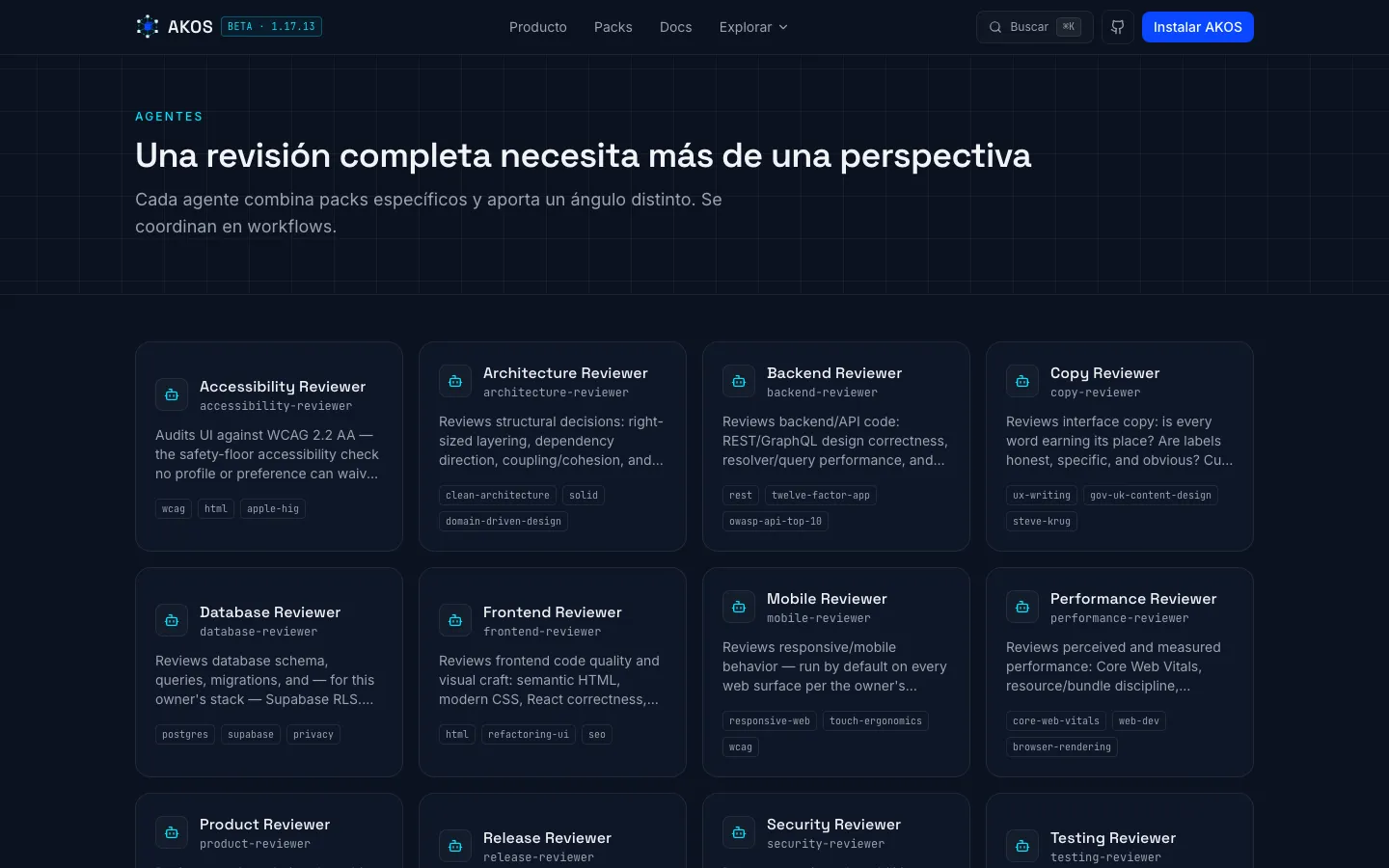
AKOS distils it: 60 packs across 12 domains (UX, architecture, security, frontend, testing…), 13 reviewer agents, and a review that ends with a clear decision on whether the work can ship.
How it works
Each pack distils one source or domain into the same file structure, so an agent fetches only the part it needs. A core layer decides who wins when sources disagree and how strict to be, from prototype to enterprise. Workflows chain the agents, rubrics score each dimension from 0 to 100, and a small CLI wires all of it into any project without overwriting anything.
The corpus is bounded on purpose: past about 60 packs, picking the right ones gets worse faster than coverage improves.
Around it
Two related pieces grew next to it. ADF, the AI Development Framework, is the environment an agent works in: a constitution, skills, agents, workflows and memory, added to a project as a git submodule. IPAUD Agentic OS is a local experiment that runs Claude Code, Codex or OpenCode in isolated worktrees per project, with verification, traces and human approval before anything is merged.
- Markdown · Bash
- Claude Code · Codex CLI
- MIT licence
Development
Packaged as a skill.
AKOS now loads as a skill in Claude Code and Codex CLI.
AKOS 1.0.
Knowledge packs, reviewer agents, workflows and scoring in one repository.
Gallery